

Creative Industry Leaders Oppose Copyright Dilution in AI Policy
Film, music, broadcasting and publishing bodies urge policymakers to anchor AI frameworks in consent, licensing and enforcement

POSTED BY:- Poonam S. Juthani
DT:-09/05/2026
9867490397

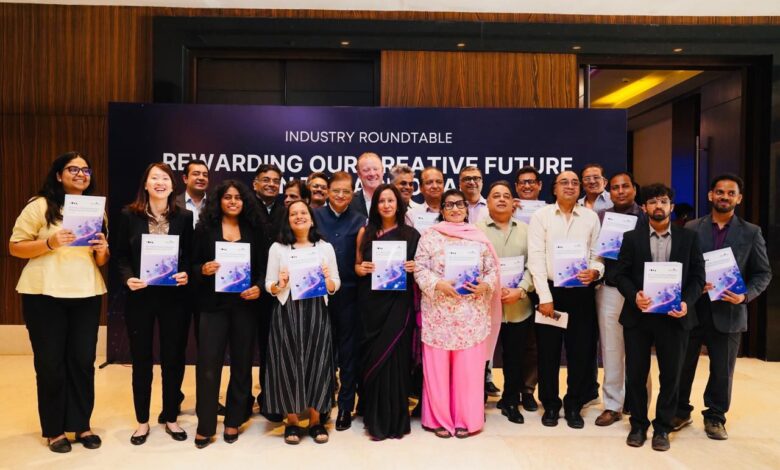
Mumbai, Delhi, Hyderabad – May 6, 2026 — Creative industry leaders from across India convened last week at three major roundtables in Mumbai, Delhi and Hyderabad to defend copyright in the age of artificial intelligence. Organisations representing film, music, publishing, and broadcasting sectors collectively called on policymakers to strengthen copyright protections, which underpin creativity, investment and jobs, rather than dilute them.
Economic Significance of India’s Creative Sector
India’s media and entertainment sector is valued at ₹2.78 trillion, contributing around 0.8% of national GDP and supporting nearly 2.8 million direct jobs alongside more than 10 million indirect jobs, according to EY’s Stories, Scale and Impact report. The sector is projected to surpass ₹3 trillion by 2027, underscoring its scale and long‑term growth potential.
Within this ecosystem, the film, television and streaming industries alone generated approximately ₹5.1 lakh crore in total economic output in 2024, supporting more than 2.6 million jobs nationwide, as highlighted in a 2025 MPA–Deloitte study. Leaders stressed that such growth depends on a stable and predictable policy environment.
Concerns Over AI Policy Proposals
Industry representatives expressed serious concerns with proposals from the Department for Promotion of Industry and Internal Trade (DPIIT) to grant blanket access to copyrighted works for AI training at government‑set rates. At the New Delhi roundtable on Generative AI, Copyright and Intellectual Property, chaired by Sanjeev Sanyal, Principal Economic Advisor to the Prime Minister, participants urged withdrawal of the proposal and reaffirmed the importance of voluntary licensing under the existing Copyright Act.
A whitepaper titled AI in the Creative Industry: Deepening the Value Chain, released by Koan Advisory in association with Creative First, showcased how India’s screen industries are already adopting AI tools to enhance filmmaking while keeping creativity at the core.
Industry Voices
Leaders across the creative industries emphasised that AI innovation and copyright protection are not in conflict. Instead, respect for copyright is essential to ensuring AI evolves responsibly and supports long‑term economic growth.
- James Cheatley, Motion Picture Association (MPA): “Strong copyright is not a barrier to innovation, but its foundation in the age of AI.”
- Abhay Sinha, Film Federation of India (FFI): “Digital India must not become free‑for‑all India—our creative works cannot be treated as raw material for someone else’s business model.”
- Sanjay Tandon, Indian Singers and Musicians Rights Association (ISAMRA): warned that unauthorised use of creative works undermines artists, investment and diversity.
- Blaise Fernandes, Indian Music Industry (IMI): highlighted global licensing deals between copyright holders and AI companies, questioning why similar frameworks should not apply in India.
- Nitin Tej Ahuja, Producers Guild of India (PGI): stressed that respect for intellectual property rights is fundamental to India’s creative economy.
- Avinash Pandey, Indian Broadcasting and Digital Foundation (IBDF): noted that India’s ambition to be a global content hub depends on trust for creators and investors.
- Suresh Dagubatti, Telugu Film Chamber of Commerce: said AI should empower creators rather than deprive them of monetisation.
- Supriya Yarlagadda, Annapoorna Studios: called for stronger enforcement against piracy and unlicensed use.
- Dil Raju, Telangana Film Development Corporation: underscored that copyright protections sustain livelihoods across the creative supply chain.
- Rishi Raj, CINEFIL Producers Performance Limited: added that strong copyright is essential to fair competition and keeping creators at the centre of innovation.
Conclusion
The roundtables in Mumbai, Delhi and Hyderabad form part of ongoing engagement between India’s creative industries and policymakers, including discussions at the India AI Impact Summit earlier this year. Leaders reiterated that India can lead globally in artificial intelligence while continuing to champion creativity, cultural expression and the rule of law.
By anchoring AI policy in consent, voluntary licensing and enforcement, India’s creative sector aims to ensure that innovation strengthens, rather than undermines, the rights of creators and the sustainability of the country’s cultural economy.