

Management Education at a Critical Juncture: 73% of B-School Leaders Expect AI-Led Transformation
EFMD and BITSOM Survey Reveals Growing Focus on AI Adoption, Critical Thinking, Research Impact, and Industry Leadership

POSTED BY:- Poonam S. Juthani
DT:-11/10/2026
9867490397
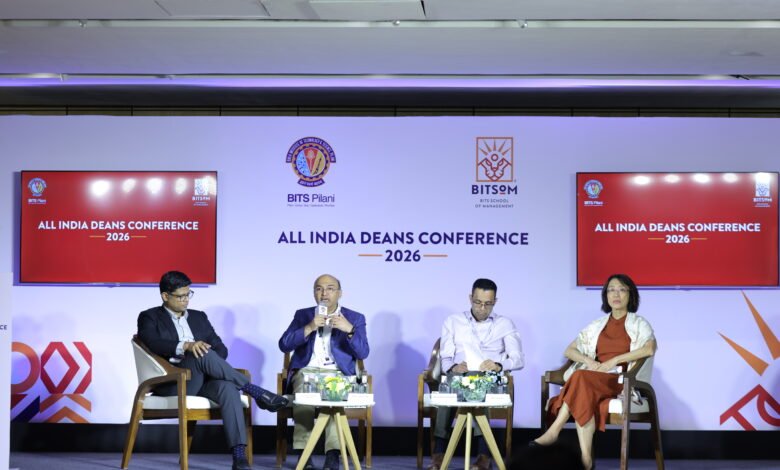
Mumbai, October 9, 2026: Artificial intelligence, rapid technological advancements, and evolving workplace practices are fundamentally reshaping global business. Against this backdrop, business schools worldwide find themselves at a defining moment. To address these changes and chart a collective path forward, the BITS School of Management (BITSOM), under the aegis of BITS Pilani, hosted its inaugural All-India Dean Conference in Mumbai, bringing together leading academic thinkers and management education leaders from India and across the world.
The prestigious conference witnessed participation from globally renowned deans and academic leaders, including Prof. Saravanan Kesavan, Dean of BITSOM; Prof. Geoffrey Garrett, Dean of USC Marshall School of Business; Prof. Vishal Gaur, Dean of Cornell SC Johnson College of Business; Prof. Kieran Fernandes, Executive Dean of Durham University Business School; and Prof. Jun Yang, Dean of Nanyang Business School, NTU Singapore, along with leaders from more than 30 leading business schools across India.
During the conference, BITSOM unveiled the EFMD-BITSOM Global Perspective Survey Report, a study based on primary insights and responses gathered from Indian business school deans and academic leaders. The report provides an evidence-based assessment of how management institutions are preparing to navigate major industry shifts and emerging educational demands.
Survey Findings Highlight Gap Between Aspiration and Execution
One of the most significant findings of the survey is that 73% of Indian B-school leaders believe that artificial intelligence will bring major or fundamental changes to management education. However, despite this strong conviction, implementation remains uneven. Nearly 38% of institutions that anticipate fundamental AI-driven transformation are still at the observation or early experimentation stage, highlighting a clear gap between ambition and execution.
The report also reveals a significant shift in attitudes toward international collaboration. An overwhelming 91% of respondents preferred broader, multidimensional global partnerships over traditional student exchange programs, which were favored by only 9%. These collaborations include joint research initiatives, faculty exchanges, industry-linked projects, and knowledge-sharing partnerships.
When evaluating international partnerships, institutions place the highest emphasis on institutional reputation (85%) and faculty quality (80%), while mutual value creation (60%) and funding support (45%) are viewed as essential factors in determining long-term viability and success.
Changing Employer Expectations Reshaping Management Education
The survey underscores growing concern among deans regarding the future relevance of business education. According to the findings, 59% of Indian deans identified changing employer expectations and evolving graduate roles as their most pressing concern. Employers are increasingly demanding graduates who can adapt to technological disruption, work across disciplines, and solve complex problems while exercising judgment and leadership.
Additionally, 54% of respondents cited changing market demand for traditional MBA programs as a key challenge, signaling the need for institutions to continuously redesign curricula to remain relevant in an evolving professional landscape.
Challenges of AI Adoption
While AI offers transformative opportunities, respondents also identified several significant challenges associated with its integration into management education.
The most pressing concern, reported by 41% of respondents, relates to governance, privacy, and responsible AI usage. Educational institutions are increasingly focused on ensuring that AI is deployed ethically and transparently.
Other key concerns include:
- Curriculum and assessment redesign (36%)
- Faculty capability development and training (32%)
These findings indicate that institutions recognize AI’s potential but understand that meaningful adoption requires structural and pedagogical change.
Reimagining Business Education
Beyond the survey findings, discussions during the conference focused extensively on rethinking the value proposition of business education.
Academic leaders emphasized that as information and routine analysis become increasingly accessible through AI tools, business schools have a unique opportunity to focus on developing distinctly human capabilities. These include:
- Strategic decision-making
- Ethical reasoning
- Empathy and emotional intelligence
- Interdisciplinary problem solving
- Leadership in complex environments
Participants strongly advocated for an “AI-first” educational approach, one that integrates artificial intelligence across disciplines while simultaneously preserving and strengthening independent critical thinking.
The conference also highlighted the need to move beyond traditional lecture-based teaching models towards:
- Project-based learning
- Industry-driven problem solving
- Experiential learning opportunities
- Collaborative knowledge creation
- Deepening campus-based networking and leadership development
Global Research and Collaboration Agenda
A major theme emerging from the conference was the need for stronger research partnerships and globally relevant management scholarship originating from India.
Academic leaders encouraged institutions to move beyond conducting research merely about India and instead focus on creating innovative management frameworks and thought leadership emerging from India that can inform global business practice.
Discussions highlighted how India’s:
- World-class digital public infrastructure
- Unique demographic dynamics
- Rapidly evolving business ecosystem
- Entrepreneurial innovation
offer opportunities to develop new management models that can contribute significantly to global academic and business discourse.
Participants also advocated for a broader vision of internationalization. Instead of limiting engagement to student mobility programs, institutions were encouraged to pursue:
- Joint degree programs
- Shared research datasets
- Collaborative faculty initiatives
- High-impact international research partnerships
There was broad consensus that future-ready business schools will succeed by functioning as collaborative, globally connected ecosystems that maintain close engagement with industry and society.
Leadership Perspectives
Commenting on the transformation underway in management education, Prof. Saravanan Kesavan, Dean of BITSOM, said:
“Business education stands at a critical inflection point due to rapid technological advancement, changing industry expectations, and the growing need for leaders capable of navigating increasingly complex environments responsibly. The inaugural All-India Dean Conference has brought together diverse perspectives from India and around the world to explore how business schools can collectively respond to these changes. Our survey report contributes valuable evidence-based insights into how Indian deans envision the future of management education. At BITSOM, we see this initiative as the beginning of a continuing dialogue that can help shape a more relevant, collaborative, and future-focused approach to business education.”
Prof. Vishal Gaur, Dean of the Johnson Graduate School of Management at Cornell University, said:
“AI will become an important enabler of MBA career development. Integrating AI into management education is an opportunity to elevate human thinking rather than replace it. As computational tools become ubiquitous, students must focus even more on critical analysis, ethical judgment, and original thinking instead of delegating strategic decisions entirely to automated systems.”
Prof. Kieran Fernandes, Executive Dean of Durham University Business School, emphasized:
“Research excellence and teaching excellence must reinforce each other. High-impact research should continuously shape classroom learning so that students benefit from the latest knowledge and insights. Global and multidimensional institutional partnerships will play a crucial role in co-creating knowledge that enhances both academic rigor and practical relevance.”
Prof. Jun Yang, Dean of Nanyang Business School, Singapore, added:
“Meeting employer expectations is important, but management education must go beyond delivering practical skills. Our responsibility is to develop leaders who possess the intellectual courage to challenge established thinking, the cultural maturity to work across boundaries, and the commitment to create responsible and sustainable change.”
The two-day conference featured keynote sessions from global academic leaders and highly relevant panel discussions focused on the Indian context. Collectively, these discussions reinforced the belief that the future of management education lies in combining technological innovation with critical thinking, global collaboration, impactful research, and human-centered leadership.