
Shri S. Gurumurthy Delivers Insightful Lecture on “RSS @ 100” at NSE Mumbai
Exploring the long-term mission of the Rashtriya Swayamsevak Sangh in a short-termist world

POSTED BY:- Poonam S. Juthani
DT:-13/03/2026
9867490397
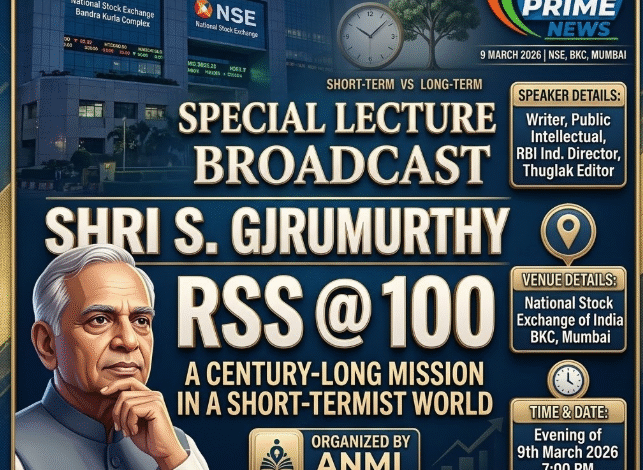
On the evening of 9th March 2026, the National Stock Exchange of India at Bandra Kurla Complex, Mumbai, hosted a special lecture that drew a distinguished audience of professionals, intellectuals, and members of the financial community. Organized by ANMI, the session featured Shri S. Gurumurthy—writer, public intellectual, Independent Director at the Reserve Bank of India, and Editor of Thuglak Weekly—who spoke on the theme “RSS @ 100: Long Term Mission in a Short-Termist World.”
The lecture began promptly at 7:00 PM, with Gurumurthy setting the tone by contextualizing the Rashtriya Swayamsevak Sangh’s century-long journey. He emphasized that while modern institutions often struggle with short-term goals dictated by immediate pressures, the RSS has consistently pursued a long-term mission rooted in cultural continuity, social cohesion, and national identity.
Drawing from historical examples, Gurumurthy explained how the RSS, founded in 1925, has evolved into one of the largest voluntary organizations in the world. He highlighted its ability to adapt to changing times without losing sight of its foundational vision. According to him, this long-term orientation has allowed the organization to withstand challenges, remain relevant, and influence multiple spheres of Indian society.
One of the key points he stressed was the contrast between short-termism in contemporary institutions—be it in politics, economics, or corporate life—and the RSS’s century-long commitment to building social capital. Gurumurthy argued that the organization’s strength lies in its grassroots presence and its ability to nurture leadership from the ground up. He noted that this approach has created a cadre of individuals who prioritize service, discipline, and community over personal gain.
The lecture also touched upon the global context. Gurumurthy observed that many societies today face fragmentation due to rapid technological change, consumerism, and political polarization. In such an environment, he suggested, the RSS’s model of sustained cultural and social engagement offers lessons in resilience and continuity. He pointed out that while institutions worldwide often collapse under the weight of short-term pressures, organizations with a long-term mission can provide stability and direction.
Throughout his talk, Gurumurthy combined historical narrative with contemporary analysis. He spoke about the RSS’s role in shaping civic life, its contribution to disaster relief, and its emphasis on character-building. He also reflected on how the organization has influenced debates on national identity and cultural values in India.
The audience listened attentively, and the atmosphere was one of intellectual engagement. Many attendees noted the clarity with which Gurumurthy articulated complex ideas, weaving together history, philosophy, and current affairs. His reputation as a sharp commentator on economic and social issues was evident in the way he connected the RSS’s mission to broader questions of institutional sustainability.
Following the lecture, there was an interactive session where Gurumurthy responded to questions from the audience. Queries ranged from the relevance of the RSS in India’s rapidly urbanizing society to its role in fostering inclusivity. Gurumurthy reiterated that the organization’s long-term mission is not about immediate visibility but about cultivating values that endure across generations.
The evening concluded with dinner, providing an opportunity for participants to reflect on the themes discussed and engage in informal conversations. The event left a strong impression on those present, underscoring the importance of long-term vision in a world increasingly dominated by short-term thinking.
In summary, the lecture by Shri S. Gurumurthy at NSE Mumbai was not just a commemoration of the RSS’s centenary but also a thought-provoking exploration of how institutions can remain relevant by focusing on enduring missions rather than transient goals. His insights offered valuable perspectives on the intersection of culture, society, and institutional longevity—making the session a memorable and intellectually enriching experience.