
Bhagyashree Deshpande Brings Rangoli Mastery to Mumbai in a Dazzling Diwali Showcase
World record-holding artist transforms tradition into immersive art, blending heritage, scale, and storytelling in a live pre-Diwali celebration

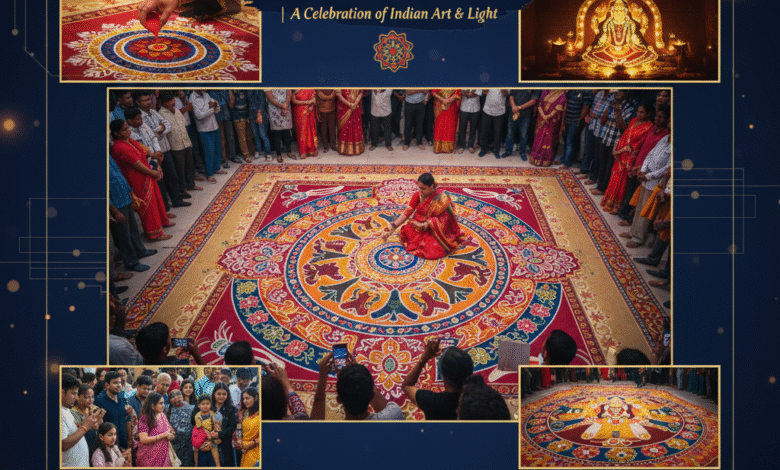

In a spellbinding celebration of color, culture, and craftsmanship, renowned Rangoli artist Bhagyashree Deshpande brought her signature brilliance to Mumbai with a live showcase that left audiences awestruck. Known for her record-breaking installations and deep-rooted commitment to preserving Indian folk art, Bhagyashree’s latest creation reaffirmed her status as one of the country’s most visionary cultural ambassadors.
The event marked a rare opportunity to witness Rangoli not just as decoration, but as performance art. With each stroke of powdered pigment, Bhagyashree transformed the floor into a canvas of storytelling—drawing from mythology, history, and contemporary symbolism. Her work is not merely ornamental; it’s narrative-driven, emotionally resonant, and technically astounding.
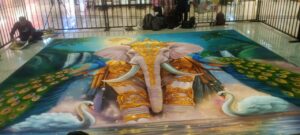
Bhagyashree’s journey as an artist is as compelling as her creations. Hailing from Pune, she has redefined the boundaries of traditional Rangoli, elevating it to global recognition. Her 1-acre Rangoli tribute to Chhatrapati Shivaji Maharaj and the towering vertical depiction of Lord Vithoba are etched in the annals of world records. These feats are not just about scale—they’re about soul, precision, and the power of visual devotion.
Her portfolio includes performances at some of India’s most iconic events: the Ayodhya Ram Mandir inauguration, Mahakumbh, and the National Games Opening Ceremony. Internationally, she has represented India in cultural showcases across the USA and London, bringing Rangoli to audiences unfamiliar with its depth and beauty.
At the Mumbai showcase, Bhagyashree’s live performance unfolded like a ritual. Each color was chosen with intention, each motif rooted in tradition. The audience watched as intricate patterns emerged—floral mandalas, divine silhouettes, and geometric symphonies—crafted entirely by hand. The process was meditative, the result mesmerizing.
What sets Bhagyashree apart is her ability to merge scale with intimacy. Whether working on a sprawling public installation or a compact stage, her art retains its emotional core. She often incorporates themes of unity, resilience, and celebration—making her work especially resonant during festivals like Diwali, which symbolize light, renewal, and community.
Beyond the visual spectacle, the event served as a platform for cultural education. Bhagyashree engaged with viewers, explaining the origins of Rangoli, its regional variations, and its evolution from domestic ritual to public art. Her advocacy for preserving indigenous art forms is matched by her efforts to modernize their presentation—using social media, live performances, and collaborations to reach younger audiences.
The showcase also highlighted the growing appreciation for folk art in urban spaces. As malls and public venues embrace experiential programming, artists like Bhagyashree are finding new platforms to share their work. This shift not only democratizes access to art but also repositions traditional forms as contemporary expressions.
Bhagyashree’s presence in Mumbai was more than a performance—it was a cultural moment. It reminded audiences of the richness of Indian heritage, the power of artistic discipline, and the joy of collective celebration. Her Rangoli was not just seen—it was felt.
As Diwali approaches, her work stands as a luminous tribute to the spirit of the festival. It embodies the values of creativity, devotion, and abundance. And in a world increasingly driven by speed and spectacle, Bhagyashree Deshpande’s Rangoli offers a pause—a moment to reflect, reconnect, and rejoice.