

Taliban Foreign Minister’s India Visit Signals Strategic Shift in South Asian Diplomacy
Amir Khan Muttaqi’s high-level outreach marks a turning point in India-Afghanistan relations, testing regional alignments and redefining engagement without formal recognition

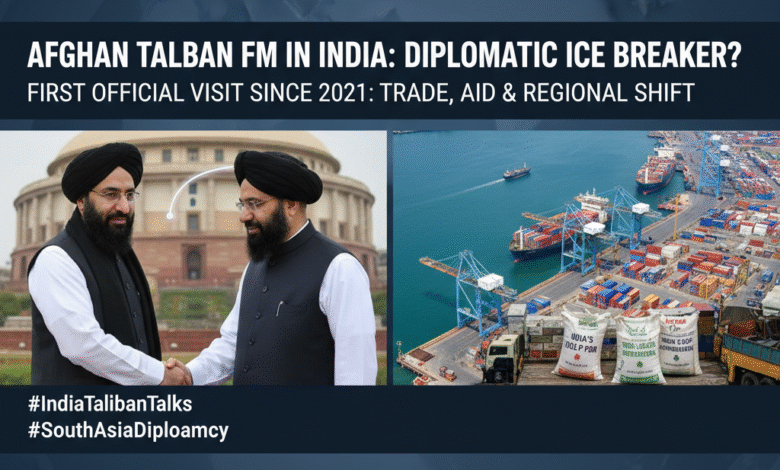
In a move that could reshape South Asia’s diplomatic contours, Taliban Foreign Minister Amir Khan Muttaqi is set to visit India—his first official trip since the Taliban’s return to power in Afghanistan in 2021. The visit, cleared under a United Nations Security Council travel ban exemption, is being viewed as a landmark moment in India’s evolving engagement with the current Afghan administration.
While India has not formally recognized the Taliban regime, the visit reflects a pragmatic shift toward structured dialogue and regional stability. The Indian Ministry of External Affairs has maintained that its engagement with Afghanistan is guided by historical ties with the Afghan people and national interest, especially in the context of humanitarian aid, counterterrorism cooperation, and infrastructure development.
Muttaqi’s visit follows months of quiet diplomacy, including earlier meetings between Indian officials and Taliban representatives in neutral locations such as Dubai. The agenda is expected to include discussions on India’s development projects in Afghanistan, regional security, and trade connectivity—particularly through Iran’s Chabahar Port, which offers Kabul an alternative route bypassing Pakistan.
India’s re-engagement with Afghanistan began in 2022 with the reopening of its technical mission in Kabul. Since then, New Delhi has provided substantial humanitarian assistance, including food, medicines, and earthquake relief. The Taliban’s public appreciation of India’s aid efforts has created a window for deeper cooperation, even in the absence of formal diplomatic recognition.
The visit also carries significant geopolitical weight. Pakistan, which has historically positioned itself as Afghanistan’s primary interlocutor, is reportedly uneasy about the warming ties between New Delhi and Kabul. Islamabad’s concerns stem from multiple factors: India’s growing influence in Afghan infrastructure, the Taliban’s openness to alternative trade routes, and allegations that Kabul is sheltering Tehrik-e-Taliban Pakistan (TTP) militants who challenge Pakistani authority in Khyber Pakhtunkhwa and Balochistan.
Muttaqi’s outreach to India is seen by many analysts as a strategic recalibration by the Taliban. By diversifying its diplomatic engagements, the Taliban aims to reduce dependency on Pakistan and gain broader international legitimacy. India, with its historical goodwill among the Afghan populace and its capacity for infrastructure investment, emerges as a natural partner in this recalibration.
Security cooperation is expected to be a key component of the dialogue. The Taliban has previously condemned terror attacks in Jammu and Kashmir, including the Pahalgam incident attributed to Pakistan-backed groups. Such statements have been welcomed by Indian officials as signs of a shared interest in regional stability and counterterrorism.
However, India remains cautious. The Taliban’s internal governance model, human rights record—especially concerning women and minorities—and its links to extremist factions continue to raise concerns. New Delhi’s approach has been to maintain a working relationship focused on practical outcomes, without endorsing the regime’s ideological framework.
The visit also comes amid broader regional shifts. China has expanded its footprint in Afghanistan through infrastructure and mining deals, while Iran continues to offer strategic access via Chabahar. India’s engagement with the Taliban is partly driven by the need to safeguard its interests in this competitive landscape and prevent strategic isolation.
For the Taliban, the visit is an opportunity to present itself as a responsible actor capable of international diplomacy. Muttaqi, a seasoned negotiator who has represented the Taliban in talks across Uzbekistan, Saudi Arabia, and Turkmenistan, is expected to advocate for increased diplomatic presence in India, including the posting of Afghan envoys to New Delhi and consulates in Mumbai and Hyderabad.
The optics of the visit are carefully managed. While it marks a diplomatic breakthrough, both sides are expected to avoid overt gestures that could be interpreted as formal recognition. Instead, the focus will be on functional cooperation—development, security, and humanitarian support.
Ultimately, Amir Khan Muttaqi’s visit to India is more than a bilateral engagement. It is a test of India’s strategic autonomy, a recalibration of Taliban diplomacy, and a reflection of the shifting power dynamics in South Asia. As New Delhi balances principle with pragmatism, the outcome of this engagement could shape the region’s trajectory for years to come.