
Dam Water Release Sparks Political Firestorm in Bengal During Festive Season
Trinamool Congress accuses Centre-run DVC of endangering lives; BJP counters with claims of procedural compliance and political theatrics

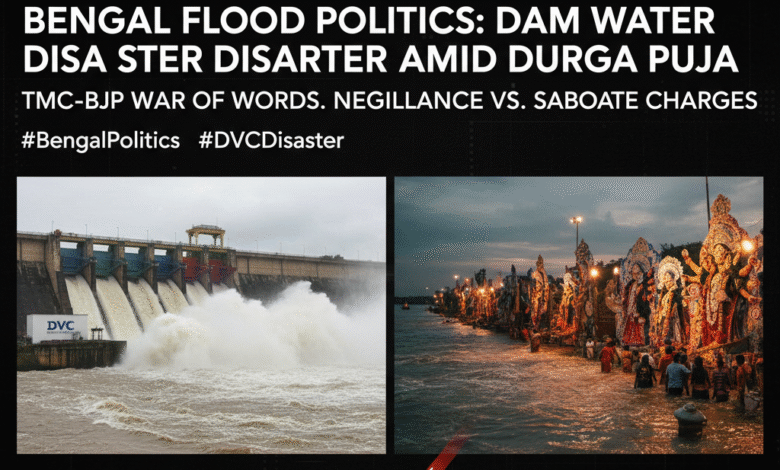
West Bengal is witnessing a fierce political standoff following the release of dam water by the Damodar Valley Corporation (DVC) during the Durga Puja festivities, triggering accusations of negligence, conspiracy, and administrative failure. The controversy has escalated into a war of words between the ruling Trinamool Congress (TMC) and the Bharatiya Janata Party (BJP), with Chief Minister Mamata Banerjee alleging that the move endangered millions of lives and disrupted sacred celebrations.
The flashpoint emerged when the DVC reportedly discharged over 65,000 cusecs of water from the Maithon and Panchet dams without prior intimation to the state government. The Chief Minister took to social media to express outrage, calling the release a “manufactured disaster” and accusing the Centre of attempting to “sacrifice Bengal during its most sacred time.” She claimed the cumulative release later surged to over 1.5 lakh cusecs, raising fears of flooding in vulnerable districts such as Purba Bardhaman, Hooghly, Howrah, Murshidabad, and Paschim Midnapore.
“This is not a natural calamity—it is a deliberate act of sabotage,” Banerjee wrote. “I will not allow anyone to carry out a Bisarjan of Bengal. Every conspiracy against our people will be resisted with full force.”
The state’s Irrigation and Waterways Minister Manas Ranjan Bhunia echoed these concerns, stating that the DVC’s actions were “shameful and unacceptable,” especially given the forecast of heavy rainfall. Emergency control rooms were activated, and district administrations were placed on high alert to monitor water levels and potential breaches.
In response, BJP leaders dismissed the allegations as politically motivated and factually incorrect. Union Jal Shakti Minister C.R. Patil cited official figures from the Damodar Valley Reservoir Regulation Committee (DVRRC), stating that only 70,000 cusecs were released—42,500 from Maithon and 27,500 from Panchet. He emphasized that the release followed standard operating procedures and that the state government had been consulted, though it failed to provide timely inputs.
“There is no congestion in the lower Damodar basin. Water levels remain below warning thresholds. The alarm being raised is baseless,” Patil wrote on social media.
BJP’s West Bengal co-incharge Amit Malviya went further, accusing Mamata Banerjee of “spreading lies” to deflect attention from her government’s failure to undertake proper river dredging and flood preparedness. “She is playing kho-kho with facts and responsibilities,” Malviya said, adding that the DVC had acted in accordance with scientific protocols.
The controversy has reignited longstanding tensions between the state and the Centre over control and coordination of water resources. The DVC, a central agency under the Ministry of Power, manages a network of dams and reservoirs across Jharkhand and West Bengal. While a state representative sits on the DVRRC, disputes over communication and accountability have persisted for years.
This latest episode has also drawn criticism from civil society groups and environmental experts, who argue that both governments have failed to develop a transparent and cooperative framework for water management. Sudden releases, especially during peak festive seasons, not only disrupt public life but also pose risks to agriculture, infrastructure, and livelihoods.
The timing of the release—coinciding with Bijoya Dashami, the culmination of Durga Puja—has added emotional weight to the issue. For many in Bengal, the festival is a deeply spiritual and cultural event, and any disruption is seen as an affront to collective sentiment.
Political analysts suggest that the clash is emblematic of deeper fault lines in Bengal’s governance model, where federal tensions often spill into public discourse. With elections looming and public sentiment running high, both parties are likely to use the controversy to galvanize their respective bases.
As the situation unfolds, the focus remains on ensuring safety and transparency. The state government has deployed disaster management teams, while the DVC continues to monitor reservoir levels. Whether this episode leads to policy reform or remains a flashpoint in Bengal’s charged political landscape will depend on the willingness of both sides to prioritize public welfare over partisan posturing.