
JNPA Accelerates Green Logistics with India’s Largest EV Truck Fleet Launch
Union Minister Sarbananda Sonowal flags off electric heavy-duty vehicles at Jawaharlal Nehru Port, marking a transformative leap toward sustainable maritime operations

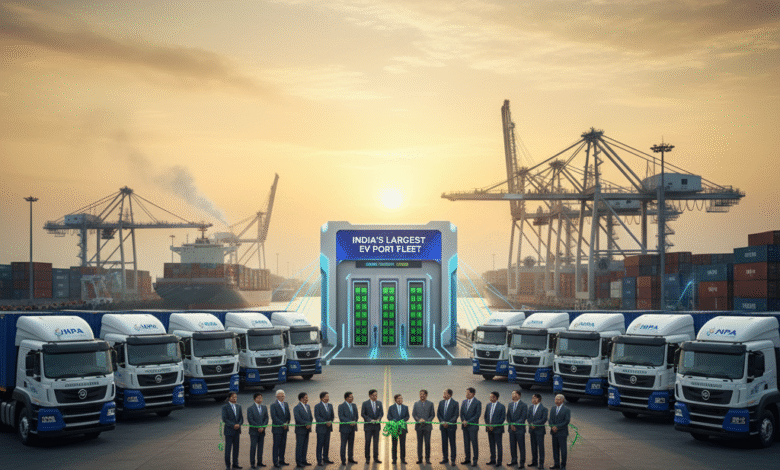
In a landmark move toward sustainable logistics and decarbonisation, the Jawaharlal Nehru Port Authority (JNPA) has officially launched its new fleet of electric trucks—India’s largest deployment of EV heavy-duty vehicles within a port ecosystem. The initiative marks a decisive step in aligning India’s maritime infrastructure with global climate goals and national mobility missions.
The flagging-off ceremony was led by Union Minister of Ports, Shipping and Waterways, Shri Sarbananda Sonowal, whose address underscored the strategic importance of electrification in port logistics. “This moment sends a message far beyond port boundaries,” he stated. “India’s ports are ready to pioneer practices that will set benchmarks for sustainability, efficiency, and innovation. With solar, wind, LNG, hydrogen, and now EVs, we are building a maritime sector that leads the world in green transformation”.
The newly inducted fleet comprises 50 state-of-the-art electric trucks, equipped with swappable battery technology and designed for high-volume cargo movement. These vehicles will operate within the Nhava Sheva Distribution Terminal and are part of JNPA’s broader plan to convert 90% of its internal truck fleet—approximately 600 vehicles—to electric by December 2026. The move is expected to significantly reduce carbon emissions, particulate pollution, and noise levels across the port’s logistics corridors.
Chairperson of JNPA and CMD of Vishwa Pragati Port Logistics (VPPL), Shri Unmesh Sharad Wagh, described the launch as a “paradigmatic leap” in port operations. “This is not merely an upgrade—it’s a redefinition of how ports can balance economic growth with ecological responsibility. We are proud to lead this transition and set a precedent for other ports across India”.
The event also witnessed the signing of a Memorandum of Understanding (MoU) between JNPA and the Isaac Centre for Public Policy (ICPP), Ashoka University. This collaboration aims to develop a Logistics Cost Index, a reference framework for port authorities to benchmark tariffs across cargo types and commodities. The index will help standardize pricing models and improve transparency in port operations.
A heavy-duty battery swapping station was also commissioned during the ceremony, enabling rapid turnaround and uninterrupted operations for the EV fleet. This infrastructure is critical to ensuring scalability and operational efficiency as JNPA expands its electric vehicle program.
The launch aligns with several national initiatives, including the National Electric Mobility Mission Plan (NEMMP), PM Gati Shakti, and the National Logistics Policy, all of which emphasize clean energy adoption and infrastructure modernization. It also supports India’s commitment to achieving net-zero emissions by 2070, as outlined in its climate action roadmap.
JNPA’s recent achievements further reinforce its leadership in the sector. The port was recently ranked among the Top 25 Ports globally in the World Bank’s Container Port Performance Index (CPPI), and has recorded milestones in container handling, SEZ development, and digitalisation. The EV fleet launch adds another chapter to this success story, positioning JNPA as a model for integrated, sustainable port management.
Industry observers have lauded the initiative as a blueprint for future-ready logistics. By integrating electric mobility into core operations, JNPA is not only reducing its environmental footprint but also enhancing its competitiveness in global trade. The move is expected to inspire similar transitions across other major ports and logistics hubs in India.
As the maritime sector continues to evolve, JNPA’s commitment to innovation and sustainability stands as a beacon of progress. The launch of the EV truck fleet is more than a technological upgrade—it’s a declaration of intent, a promise to future generations, and a bold stride toward a cleaner, smarter, and more resilient India.